
The Metrocrest Connection: How Data Centers Already Show Up in Carrollton, Addison, Farmers Branch, and North Texas
The Metrocrest Connection: How Data Centers Already Show Up in Carrollton, Addison, Farmers Branch, and North Texas
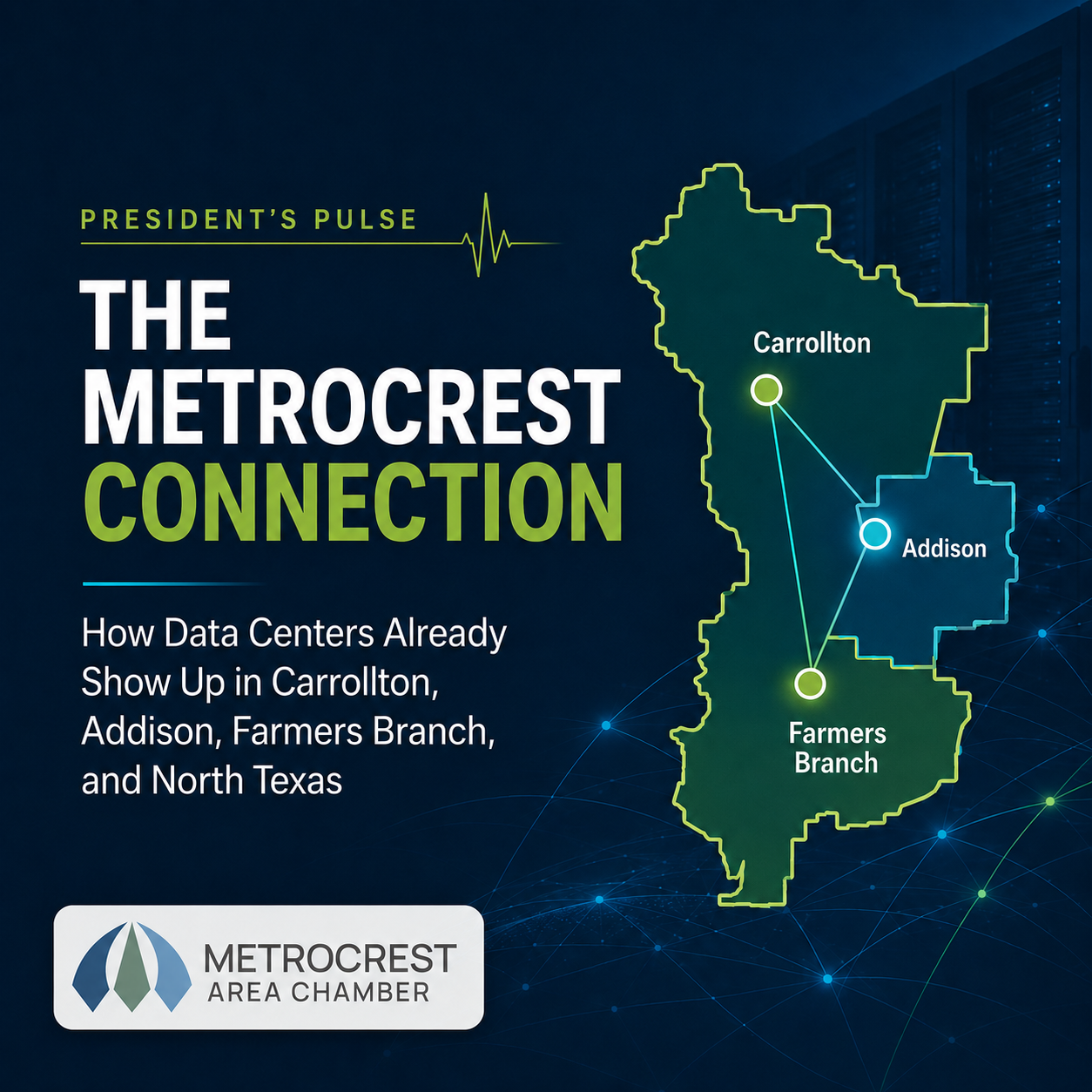
When people hear “data center,” they may picture something new that could come to the region someday.
But for Metrocrest, this is not just a future issue. Data centers and data-center-related companies are already part of the local and regional economy.
They show up in several different ways: major operating facilities, public safety infrastructure, colocation providers, technology companies, operations centers, cooling manufacturers, cloud and managed-service firms, and regional hyperscale development.
That distinction matters. Not every data center is the same, and not every company connected to the data center economy operates a giant building full of servers. Some provide cooling technology. Some manage critical infrastructure. Some support business continuity, cybersecurity, hosting, cloud services, or public safety. Some are large regional projects that affect the broader North Texas conversation around water, power, workforce, tax base, and ratepayer protection.
This post offers a public-source snapshot of how the data center economy already connects to Carrollton, Addison, Farmers Branch, and North Texas.
Carrollton has the clearest data center footprint in Metrocrest
Carrollton has the most visible data center presence in the Metrocrest area.
CyrusOne’s DFW1 facility in Carrollton is described by the company as the largest data center facility in Texas. CyrusOne says the site includes 600,000 square feet of technical IT space, 90 megawatts of total IT capacity, zero-water-consumption cooling, and minimal water use for humidification and facility maintenance. CyrusOne also says the facility is Net Positive Water certified.
That matters because one of the most common concerns about data centers is water use. The Carrollton example shows why communities should ask specific questions about technology, not rely on broad assumptions. Some data centers can use significant water. Others are designed to reduce water demand substantially. The details matter.
Carrollton’s data center connection is also tied to public safety. In 2014, the City of Carrollton announced that the North Texas Emergency Communications Center, known as NTECC, would be housed at the CyrusOne facility in Carrollton and would serve Carrollton, Addison, Coppell, and Farmers Branch. The city said the shared dispatch model was designed to improve response times, reduce duplication of services, and reduce costs.
The city’s announcement said the NTECC space would occupy 12,000 square feet within the CyrusOne facility and would benefit from security, cloud computing technology, and stronger defenses against natural disasters. The same announcement said the project represented a $7 million capital investment and projected more than $12 million in savings over 20 years, including $3.6 million for Carrollton and its residents.
That public safety story is still evolving. In 2025, Carrollton announced a groundbreaking for a new NTECC facility serving Carrollton, Coppell, Farmers Branch, and Addison. The city said NTECC currently operates from leased space in Carrollton and that building a new facility would be approximately $25 million more cost-effective over 30 years than continuing current leasing arrangements. The city also noted that NTECC was the first dispatch center in Texas to implement an all-digital NextGen911 system using AT&T ESInet.
For Metrocrest, the lesson is clear: data centers are not just anonymous industrial buildings. In some cases, they are part of the infrastructure that supports emergency communications, regional cooperation, public safety, business continuity, and community resilience.
Carrollton also has colocation, cloud, and technology providers
CyrusOne is not the only data center presence in Carrollton.
Digital Realty lists two Carrollton facilities in its Dallas data center portfolio: DFW11 and DFW12. Digital Realty’s Dallas portfolio page lists DFW11 in Carrollton at 100,600 square feet and DFW12 in Carrollton at 135,300 square feet. The company describes Dallas as a major data center market with colocation opportunities, more than 140 cloud and network service providers, and a broader ecosystem of customers and connectivity.
VAZATA also lists Dallas-area data center services in Carrollton. Its Dallas DAA facility is described as a Carrollton location for managed cloud hosting, data center relocation, colocation, and hybrid infrastructure, with 25,000 square feet of move-in-ready Tier III data center space with Tier IV attributes. VAZATA also lists Dallas DAB as a facility for colocation, business continuity, disaster recovery, and managed IT services.
Carrollton is also home to M&A Technology, a local technology company that describes its owned and operated data centers as providing security, hosting, colocation, backup, business continuity, and tailored business solutions. M&A lists a 6,000 square foot data center, SOC 2 compliance, 24/7 monitoring, colocation, hosting, hybrid cloud solutions, managed services, redundant power, generator backup, and an on-site manned Network Operations Center.
This matters because the data center economy is broader than the largest campuses. Smaller providers and technology companies also support local businesses that need secure hosting, backup, cloud services, business continuity, managed services, and cybersecurity support.
Carrollton is also part of the data center supply chain
One of the most interesting parts of the Metrocrest story is not just where data is stored. It is how the industry is supported.
LiquidStack, a liquid cooling company headquartered in Carrollton, announced in March 2025 that it had opened a second manufacturing facility in Carrollton. The company said the new 17,000 square foot facility would increase production capacity while serving as a research and development and service training facility. LiquidStack described itself as a leader in liquid cooling for data centers and said demand for high-performance cooling had increased as AI workloads scaled up in data centers.
LiquidStack also said it was expanding its Carrollton team with new positions across multiple departments and that its Carrollton facilities manufacture a portfolio of liquid cooling solutions, including direct-to-chip and immersion cooling systems.
In 2026, Trane Technologies announced it had completed its acquisition of LiquidStack, describing the Carrollton-headquartered company as a global leader in liquid cooling technology for data centers. Trane said the acquisition strengthens its position in advanced thermal management for mission critical operations and expands its ability to provide integrated data center cooling solutions.
That is a different kind of economic development story. It is not just a data center building. It is manufacturing, engineering, research and development, service training, cooling technology, and jobs connected to one of the fastest-growing infrastructure sectors in the country.
Addison’s connection is operations, expertise, and professional services
Addison’s publicly documented connection to the data center economy looks different from Carrollton’s.
Based on public sources, Addison’s role is less about a large confirmed hyperscale facility and more about operations, monitoring, facility support, and professional services connected to the data center sector.
BCS Data center Operations announced in 2020 that it had fully occupied its corporate headquarters and Tactical Operations Center in Addison. The company described BCS as a data center operations provider and said the Addison location included a 24/7/365 remote monitoring, maintenance, and response center. BCS said the Tactical Operations Center provides data center owners with critical facility support, physical security oversight, tactical incident management, and reporting.
BCS also said it provides data center facility management, physical security, and IT services. At the time of the announcement, the company said it had more than 6.8 million square feet of critical infrastructure under contract and served 28 data centers with 150 megawatts of data center critical power under contract.
This is important for how Metrocrest talks about the sector. A community’s data center economy can include headquarters, operations centers, engineers, security professionals, facility managers, monitoring teams, and technical support providers, even if the community is not home to a large data center campus.
Farmers Branch connects through colocation, data-center-ready facilities, and infrastructure services
Farmers Branch also has a role in the Metrocrest data center story. Its presence is not defined by one large, highly visible campus, but by companies and facilities that support data storage, colocation, hosting, cloud strategy, and the technology infrastructure businesses rely on.
Farmers Branch is part of the data center story through Möbius Partners. Its Farmers Branch office traces back to neGma Business Solutions, a Dallas-area provider of colocation data center and managed services that Möbius acquired in 2023. Today, Möbius offers data center, cloud and edge solutions, colocation, data center hosting, managed services, and other technology infrastructure support for businesses.
This is a useful example of the broader digital infrastructure economy. Not every company connected to data centers operates a large campus. Some provide the services, systems, and expertise that help businesses store, protect, manage, and access their data.
Farmers Branch is also connected to the industry through data-center-capable real estate and infrastructure. Public data center sources identify Digital Realty DFW14 in the Farmers Branch and North Dallas area as an operational data center, and commercial real estate listings identify Alpha Data Center in Farmers Branch as a specialized facility with power, generator, HVAC, security, and fiber infrastructure designed to support data center use.
DataSpan adds another piece to the local picture. Based in Farmers Branch, the company provides IT physical infrastructure, data center IT services, storage, hybrid cloud, and co-location support. Companies like DataSpan help show how the data center economy extends beyond the facilities themselves and includes the vendors, service providers, and technical experts that help businesses build, manage, and modernize their technology environments.
Together, these examples show that Farmers Branch is connected to the data center economy in several ways: colocation, managed services, data-center-capable facilities, technology infrastructure, and business support. That matters because each part of the industry has different implications for land use, power demand, water use, jobs, and community fit.
North Texas is one of the country’s major data center markets
The Metrocrest story sits inside a much larger North Texas trend.
CBRE reports that Dallas-Fort Worth is a 1 gigawatt colocation data center market with a 2.4 percent overall vacancy rate. CBRE also reports approximately 700 megawatts of under-construction colocation space that is 94.5 percent preleased, plus another 3 gigawatts of planned greenfield development. Demand from hyperscalers and AI providers remains strong, while power delivery and power-queue issues are becoming more important.
JLL’s 2026 reporting shows the scale of the broader Texas market. JLL says Texas accounts for 6.5 gigawatts of data center capacity under construction and could overtake Virginia as the largest global data center market by 2030. JLL also notes that grid connection timelines averaging four years or longer are changing how major users plan data center development.
Regional examples show why Metrocrest should be paying attention. Google lists Texas data center locations in Midlothian and Red Oak, and says it announced a $40 billion investment in Texas cloud and AI infrastructure through 2027, including new data center campuses elsewhere in the state. Google also says it is bringing new energy resources onto the grid, paying costs associated with its operations, creating a $30 million Energy Impact Fund, and supporting electrician training in Texas.
South of Dallas, Skybox Datacenters lists PowerCampus Dallas as a 300 megawatt, 1 million square foot, 115-acre project with a private onsite substation, designed for hyperscale users. Yondr Group announced in 2025 that it had secured a 163-acre site in Lancaster, just south of Dallas, for a campus with capacity for 550 megawatts of critical IT load, with groundbreaking expected in 2026.
These projects are not in Metrocrest, but they shape the regional conversation. They affect how North Texas thinks about power, water, transmission, workforce, infrastructure, land use, tax base, and ratepayer protection.
Why this matters for Metrocrest
The local connection matters for three reasons.
First, data centers and data-center-related companies already support services that residents and businesses rely on every day. That includes public safety, cloud platforms, cybersecurity, business continuity, financial systems, health care records, logistics, remote work, and the software tools used by small and large businesses.
Second, the industry’s economic footprint is broader than the buildings themselves. It includes construction, electrical work, HVAC and cooling technology, physical security, fiber, engineering, managed services, facility operations, suppliers, professional services, and specialized workforce training.
Third, the presence of these assets makes responsible policy more important. Communities can be supportive of economic development while still asking practical questions about water, power, ratepayer protection, noise, aesthetics, land use, backup generation, public benefits, and long-term infrastructure costs.
That is the balance this series will continue to explore.
Data centers are already part of the Metrocrest and North Texas story. The question now is how our communities can understand them clearly, evaluate them responsibly, and make sure future growth benefits residents, businesses, and the region.
What’s next
In the next post, we will look more closely at the economic impact of data centers: tax base, construction activity, jobs, suppliers, public revenue, and the difference between short-term activity and long-term community value.
Know of a data center, technology company, operations provider, cooling company, fiber asset, cloud provider, or related business in Addison, Carrollton, Farmers Branch, or North Texas that should be included in this conversation? Contact the Metrocrest Area Chamber at info@metrocrestchamber.com.
