
Jobs and Workforce: The Honest Story About Data Center Employment and Opportunity
Jobs and Workforce: The Honest Story About Data Center Employment and Opportunity
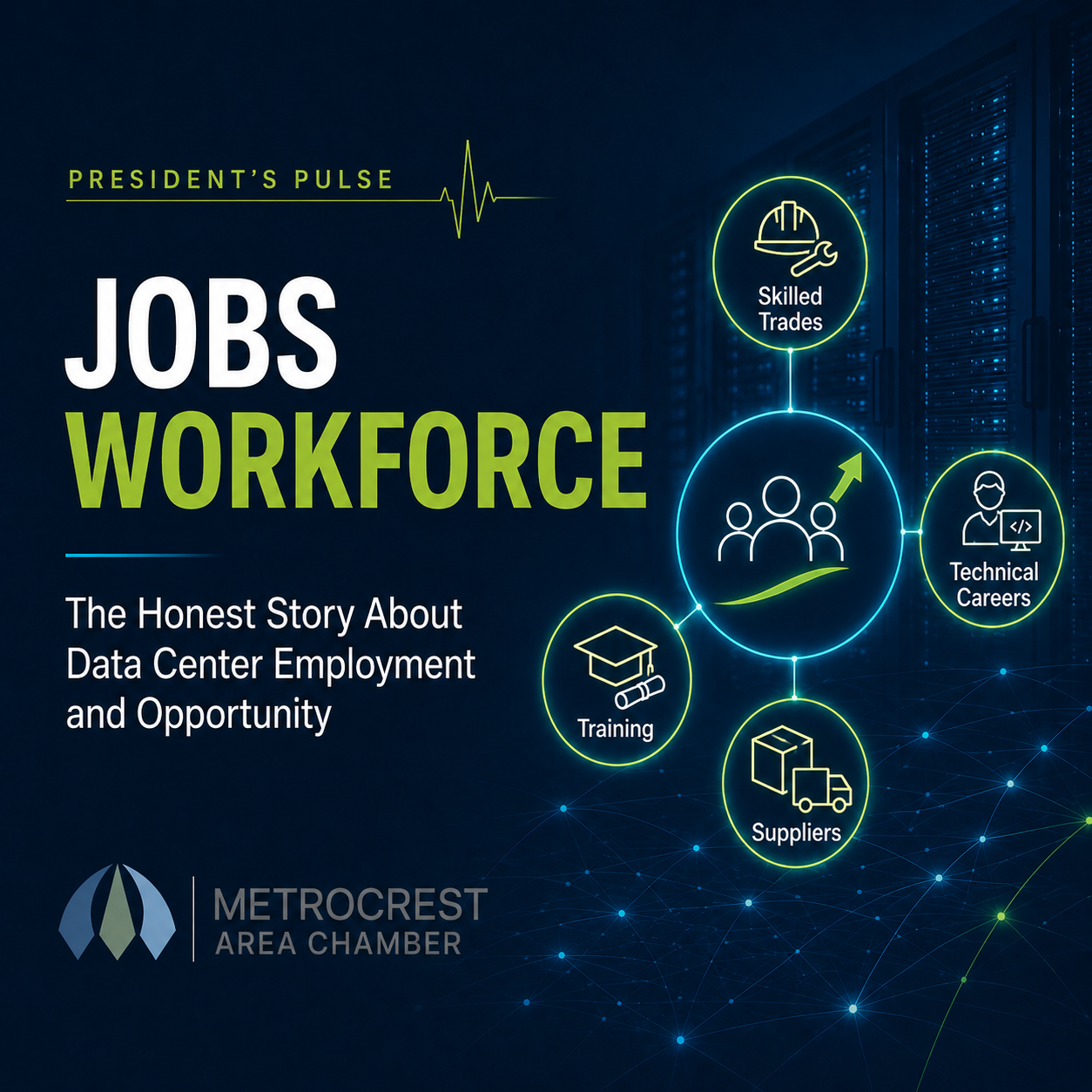
One of the biggest questions communities ask about data centers is simple:
“How many jobs do they actually create?”
It is a fair question, and it deserves an honest answer.
Data centers do create jobs, but the workforce story is often misunderstood. Supporters sometimes overpromise permanent employment. Critics sometimes dismiss the industry entirely because staffing levels inside a completed facility may be smaller than those of a major corporate headquarters or manufacturing plant.
The reality is more nuanced.
Data centers can support meaningful economic activity through construction, skilled trades, engineering, operations, cooling technology, security, fiber infrastructure, managed services, and supplier networks. But the number of permanent workers inside a completed facility is often smaller than residents expect.
Understanding that difference matters because communities should evaluate projects based on the full picture, not unrealistic assumptions.
For Metrocrest and North Texas, this conversation is especially important because the region already has companies connected to colocation, cloud services, cooling technology, managed services, infrastructure operations, and digital infrastructure support.
The permanent job count is usually smaller than people expect
A modern data center can represent hundreds of millions or even billions of dollars in investment, but it may not employ thousands of people onsite every day.
The World Resources Institute reviewed more than 1,200 U.S. data centers and found that even the largest facilities often employ fewer than 150 permanent workers, and in some cases as few as 25. WRI noted that data centers typically require fewer employees because many systems are automated and facilities are designed for operational efficiency.
That does not mean the jobs are insignificant. It means the conversation should be specific about the kinds of jobs being created.
Permanent onsite positions can include:
- Facility managers
- Data center technicians
- Network engineers
- Electrical and mechanical specialists
- HVAC and cooling technicians
- Cybersecurity professionals
- Physical security personnel
- Operations and monitoring staff
- Facilities maintenance teams
- Compliance and reliability specialists
Construction and skilled trades are a major part of the workforce impact
The strongest workforce impact from a new data center project is often during planning and construction.
Large facilities require electricians, pipefitters, HVAC specialists, concrete crews, steel workers, engineers, project managers, equipment installers, fiber and telecommunications contractors, security contractors, and many other skilled trades.
The World Resources Institute notes that data center construction can generate hundreds of temporary construction jobs, many of them well-paying positions tied to specialized infrastructure work.
That matters for North Texas because the region already has a strong construction, engineering, and infrastructure workforce.
As artificial intelligence and high-density computing continue to grow, demand is also increasing for specialized cooling, electrical, and power-management expertise. This creates opportunities not only for workers inside the facilities, but also for manufacturers, suppliers, contractors, and service providers that support the industry.
Carrollton-based LiquidStack is one local example. The company announced in 2025 that it was expanding its Carrollton manufacturing footprint to support growing demand for liquid cooling systems used in AI and high-performance computing environments. LiquidStack said the expansion would support manufacturing, research and development, and service training operations.
That is an important reminder that the workforce impact is often broader than the data center building itself.
The supplier ecosystem creates additional opportunity
The data center economy includes far more than server racks and computer equipment.
A single project may involve:
- Electrical contractors
- Mechanical contractors
- Cooling manufacturers
- Generator suppliers
- Fiber providers
- Security companies
- Software vendors
- Engineering firms
- IT service providers
- Facility maintenance providers
- Landscaping and grounds services
- Professional services firms
- Logistics and transportation support
That creates opportunities for chambers of commerce, workforce boards, schools, technical programs, and local businesses to connect with a growing digital infrastructure economy.
Metrocrest already has examples of this broader ecosystem. Carrollton includes colocation and infrastructure providers. Addison includes operations and facility-management expertise tied to data center operations. Farmers Branch includes managed services, cloud infrastructure support, and colocation-related business activity.
The takeaway is important: not every economic opportunity tied to data centers happens inside the facility itself.
Texas is already a major data center employment state
The workforce impact is not theoretical.
The U.S. Census Bureau reported that employment in U.S. data centers increased by more than 60 percent between 2016 and 2023, growing from 306,000 to 501,000 workers nationwide. Texas accounted for approximately 10 percent of total U.S. data center employment.
The same Census report found that nearly 75 percent of Texas data center employment was concentrated in Travis, Bexar, Collin, and Dallas counties.
That means North Texas is already one of the country’s major data center labor markets.
CBRE also reports that Dallas-Fort Worth remains one of the nation’s largest colocation markets, with a 1 gigawatt colocation market, approximately 700 megawatts of under-construction colocation space that is 94.5 percent preleased, and another 3 gigawatts of new greenfield development planned.
As the industry grows, the workforce conversation is becoming less about whether jobs exist and more about whether communities are prepared to train workers for them.
Workforce preparation matters
One of the biggest opportunities tied to data center growth may be workforce development.
The industry increasingly needs workers with expertise in:
- Electrical systems
- HVAC and cooling systems
- Fiber and networking
- Industrial maintenance
- Cybersecurity
- Cloud infrastructure
- Data center operations
- Physical security
- Backup power systems
- Controls and automation
That matters for communities trying to connect residents with stable, high-paying careers tied to long-term infrastructure growth.
Google’s recent Texas infrastructure announcement included a commitment to help train existing electrical workers and more than 1,700 electrical apprentices in Texas by 2030. The company also announced a $30 million Energy Impact Fund and more than 6,200 megawatts of new energy generation and capacity contracted to date through power purchase agreements with energy developers.
Not every project will involve workforce commitments at that scale. But communities can still ask whether developers and operators are partnering with local workforce programs, trade schools, community colleges, or apprenticeship organizations.
Communities should avoid overselling the jobs story
At the same time, communities should avoid unrealistic promises.
A data center is not the same thing as a large manufacturing campus, distribution hub, hospital system, or corporate headquarters with thousands of employees.
Communities that oversell permanent employment numbers risk creating public frustration later.
A better approach is honesty.
The strongest workforce argument for data centers is usually not massive permanent staffing. It is the combination of:
- Skilled construction activity
- Technical and engineering jobs
- Long-term infrastructure operations
- Supplier and vendor opportunities
- Manufacturing and cooling technology
- Managed services and cloud support
- Workforce training partnerships
- High-paying technical careers
Workforce discussions should include local businesses too
One of the most overlooked parts of the data center conversation is how local businesses fit into the picture.
Chambers of commerce can help local companies understand where opportunities exist in:
- Construction
- Electrical work
- HVAC and cooling
- Security
- Landscaping
- Facility maintenance
- Technology services
- Engineering
- Professional services
- Supplier relationships
- Workforce training partnerships
That is especially relevant in Metrocrest, where many businesses already operate in technology, engineering, infrastructure, commercial services, and business support sectors.
The Metrocrest takeaway
The workforce impact of data centers is real, but it should be discussed honestly.
The industry may not create massive onsite employment numbers compared with some other land uses. But it does create opportunities in construction, engineering, skilled trades, cooling technology, operations, infrastructure services, managed services, and supplier networks.
The jobs also tend to be technical and infrastructure-focused. They can connect workers to long-term careers in electrical systems, mechanical systems, networking, cooling, cybersecurity, security, and facility operations.
For Metrocrest and North Texas, the bigger opportunity may be positioning local workers, businesses, schools, and workforce programs to participate in a growing digital infrastructure economy.
Responsible growth means understanding both the opportunities and the limitations. Communities should neither oversell nor dismiss the workforce impact.
The smartest approach is practical, transparent, and forward-looking.
What’s next
In the next post, we will take a closer look at water, cooling systems, and infrastructure concerns: how different types of data centers use water, why cooling technology matters, and what communities should ask before supporting future projects.
